Today I’d like to share a little from my personal life and how I’m trying to shape it into something more desirable for me. For me, “more desirable” especially implies more connected to nature—and from that follows “healthier” and “more balanced.”
The biggest and most important challenge…
…for a person striving for a happier and more fulfilling life, in my conviction, is to live according to one’s own ideals. What, that’s it already? Yes. Even though the sentence sounds trivial, it’s not at all easy to put into practice.
Wherever you look, whoever you talk to—most of the problems people face are self-made in the sense that there is too large a gap between (1) what one considers desirable, one’s ideal life, and (2) what one actually lives.
I call this a life-discrepancy. In healthy amounts (as with everything), such a discrepancy is not harmful, but rather helps a person develop along a constructive path toward their goals. But a person with too large a life-discrepancy is rarely happy, because they constantly have to measure themselves against their ideals—which are so very high—and realize again and again that they fail to live up to them.
A life-discrepancy can have internal and external causes. We can work on both types:
- Internal causes might be, for example, setting one’s ideals unrealistically high, making achievement impossible or frustrating from the outset. Another internal cause is the proverbial inner couch potato (or “inner resistance”). We can address these directly by becoming aware of them and changing our mindset—by overcoming that resistance or by setting more realistic expectations.
- External causes are first determined by factors outside of ourselves: people around us, friends, family, work, society with its expectations and social norms, but also the technological possibilities of the time. All this influences how we live (spending free time at the PC/in front of the TV instead of playing board games with others; commuting by car/bus/train instead of walking), as well as our norms, values, ideals, and goals.
This can mean that (1) external influences keep us from following our own ideals and goals, or (2) these influences shift our ideals and goals into the unrealistic. Generally, one can address external causes by becoming more independent of these influences, negotiating compromises, or—if that’s not possible—completely breaking away. This can be very difficult, for example if one’s job is the main reason for not living in line with one’s goals. We do read about radical breakaways from society from time to time, and while I find this tempting, it surely comes with many drawbacks. For me, compromise seems more desirable.
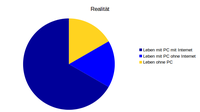
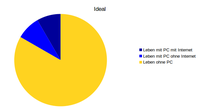
I’d like to illustrate my situation with two graphics:
The reasons
In short, my life-discrepancy is mainly due to the faulty prioritization of “PC/Internet” and “life without PC.” This discrepancy has long left me with the feeling that I’m wasting my time and not really making the most of my life.
I do a lot of things to pursue my ideals (helping people, doing something good for humanity), but my own growth and longings are mostly left behind (more closeness to nature, hiking, a few solitary hours).
The causes are a mix of internal and external factors, with external ones prevailing: internal factors include introversion and the resulting inertia. The weighty external factors are the way our society functions and the forms it takes today. Everything is already, and increasingly, made convenient (transport reduces physical movement, the Internet as a social medium reduces real-world encounters, technological achievements like PC/Internet/consoles have a high addictive potential).
The latter is the main reason I find it so hard to climb out of the “digital swamp”: I’m addicted! And not only me, but many people around me too.
But is that really the cause?
No. Because if I trace the causal chain further, I must admit: the reason I give in to these external temptations and cannot escape the digital swamp is often my stress level and “hamster-wheel lifestyle.”
There are weeks and months where I stumble from one deadline to the next, constantly feeling I’m running behind and never able to do anything 100%. In these times, my health suffers (neurodermatitis), my social life (I don’t go out), and also the balance of my activities and priorities.
In these phases, I spend much more time at the PC (not only work-related, but also because I lack energy for social activities) and eat more unhealthy foods, which I’d actually like to avoid according to my ideals. But that, too, is not the core problem, because why do I even push myself professionally like this?
Those are also ideals—but ones strongly indoctrinated by society/family, namely: be hardworking, be successful at work, it’s good to help humanity!
In summary: in my stressful phases I pursue externally-given ideals, and thereby neglect my instinctive and deep wishes: to live more connected to nature, more consciously, and less dependent on PC/Internet.
With my good friend Y., I’ve long shared this “balancing act” between the extremes of technology and nature. We both work in IT, but are also passionate nerds in our private lives. We enjoy tinkering with PCs, writing or testing new software/scripts. Which brings us back to addiction. We’ve tried several approaches to reconcile both passions.
But for me, it’s becoming increasingly clear that the two (for me) cannot be reconciled directly. That’s why I’ve long wished to cut down on PC time and lead my life in a more natural way—or rather, to lead it there for the first time, since I’ve never really been there: born in 1986 and raised in a non-poor household, I could retreat into the tech world without hindrance. I grew up with it and sought PC-minded friends. After years of this lifestyle, I remain so deeply rooted in PC-thinking that I can only free myself with effort.
At extreme times, every other activity had to measure up against how much I wanted to put the PC/laptop aside.
Meanwhile (thank God), I’m beginning to develop unconscious resistances against constant PC use: always being online in messengers, endless MMORPGs or multiplayer games (which can in principle go on forever). My taste in games has also changed: while I used to play shooters, strategy, RPGs, and basically anything, now I limit myself to (1) indie titles that speak to a deep longing (often related to nature, e.g. The Long Dark), (2) very complex games that make me think and don’t follow a formula, and (3) multiplayer titles with real friends. This is just one aspect of my digital life that has shifted for me in a more natural and important direction.
A plan
During my last visit to Y., we discussed many of these aspects, and after I (again) loudly complained about my lifestyle, we came up with a plan.
Because it’s hard to free oneself from the PC/Internet swamp on one’s own, we work together. Using workrave , we both log and track how much time we spend at the PC each day—distinguishing between work and private use.
My plan includes:
On workdays, max. 1.5h leisure PC use.
On non-workdays, max. 3h PC use.
Rewards (the carrot)
For every hour we spend less at the PC, we may (with good conscience!) watch two episodes of a series or a film on the same day.
Penalties (the stick)
For every additional hour started, we pay €1 into our shared travel fund (today I owe €5).
How do we use the new time?
We both set priorities for using the freed-up time. My top four are: (1) more social activities, (2) more sport, (3) more nature (e.g. greenhouse), (4) more reading.
Mutual exchange
We want to exchange regularly about how it’s going and where it’s stuck. To stay motivated, it’s important to talk especially when failing. Every two weeks we’ll reevaluate the plan and improve it if needed.
How things go for us, you’ll soon read here and on Y.’s blog (link to follow)!